 Aeronautics
Luxury Yacht Equipment – Design Support
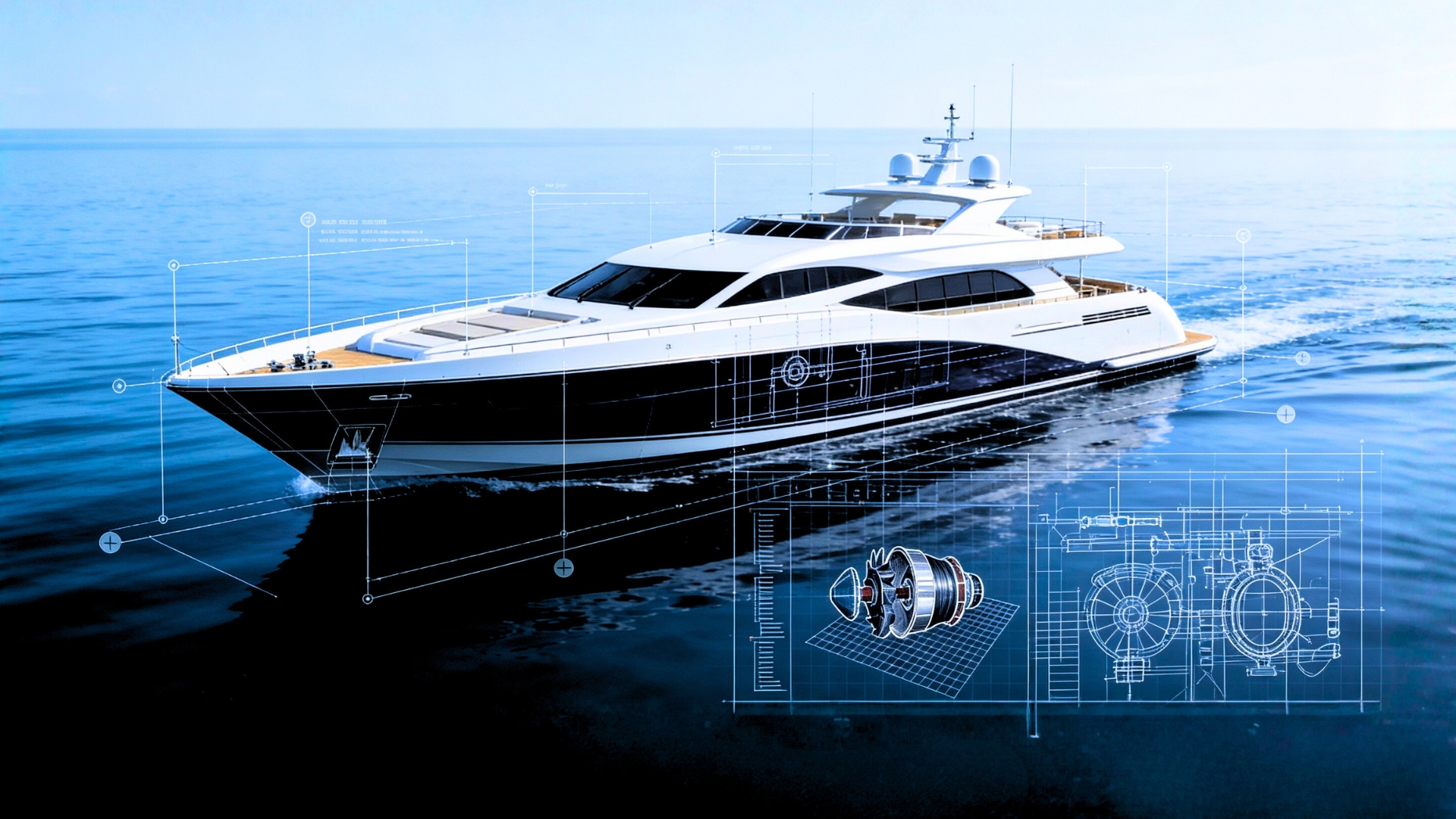
A leading global Yacht equipment OEM partnered with ALTEN to tackle the integrating complex systems into confined spaces, ensuring flawless performance throughout a yacht’s lifespan and critical challenge of reducing unit manufacturing costs without compromising on safety, performance, and quality standards. ALTEN stepped in with a structured, design-led, and cross-functional approach delivering not just cost savings, but faster execution cycles and stronger collaboration across engineering.

Project Summary & Overview:
The Beach Club Platform project involved developing a hydraulic Actuators folding platform system that transforms the stern area of the yacht into a luxurious beach club zone, providing direct access to the sea.
The project required a custom-engineered, lightweight, and corrosion-resistant platform capable of withstanding marine conditions while ensuring smooth hydraulic operation, minimal noise, and seamless integration with the yacht’s hull structure and aesthetic.
- Retract flush into the yacht, remaining invisible when not in use.
- Operate quietly and smoothly, with proportional control.
- Integrate safety rails, lighting, and anti-slip surfaces.
- Be service-friendly and compatible with the yacht’s hydraulic power unit (HPU).
- Meet Lloyd’s Register safety and structural requirements
The Scope of Work:
Concept & Design Engineering:
- 3D modeling of the beach platform.
- Interface design with yacht hull and adjacent structures.
Structural Analysis:
- Load calculations (static, dynamic, and sea-load conditions).
- Verification of hinge points, hydraulic cylinders, and locking mechanisms.
Hydraulic System Integration:
- Selection and layout of hydraulic cylinders and control units.
Material & Component Specification:
- Use of marine-grade aluminum/stainless steel.
- Surface treatment for corrosion resistance.
Manufacturing & Assembly Support:
- Preparation of production drawings and installation guidelines.
Key Sections (Use Bullet Points)
Challenge:
- Complex Geometry & Limited Space: The stern curvature and compact integration zone required precise hinge alignment and compact hydraulic arrangement.
- Load and Stability: Platform needed to withstand wave impacts and personnel load without excessive deflection or vibration.
- Corrosion and Weight Optimization: Achieving lightweight structure without compromising strength and marine durability.
- Tight Tolerances: Ensuring exact matching of platform to hull when closed to maintain watertight integrity and yacht aesthetics.
- System Synchronization: Hydraulic cylinders needed synchronized motion for smooth folding and unfolding operation.
Solutions:
- Advanced 3D Parametric Modeling: Used CAD to ensure accurate hinge geometry and clearance optimization.
- Material Optimization: Designed structural frames using lightweight aluminum with stainless steel hinges for strength and corrosion resistance.
- Sealing & Finishing Innovation: Developed custom rubber sealing arrangements and hidden locking systems to maintain visual appeal and watertightness.
- Use of special bulb profile: It has a flat web with a small bulb-shaped edge on one side — this unique shape provides high strength with low weight, making it ideal for stiffening ship structures.
Benefits/Results:
- Enhanced User Experience: Provides luxurious sea-level lounging and swimming access, transforming the yacht’s functionality.
- High Reliability & Safety: Robust design with tested hydraulic and structural integrity ensures long service life.
- Aesthetic Integration: Flush fit with hull lines and premium surface finish maintain yacht elegance.
- Ease of Maintenance: Modular components and accessible hydraulic lines simplify inspection and servicing.
- Operational Efficiency: Smooth, synchronized platform deployment with minimal noise and vibration.
Knowledge Where It Counts
The project demonstrates expertise in precision engineering, marine hydraulics, and complex motion mechanisms.
Key technical learnings include:
- Importance of 3D kinematic simulations for compact motion designs.
- Integration of hydraulics with electronic control systems for synchronization.
- Application of marine-grade materials and coatings for longevity.
- Managing tight tolerances and alignment in confined installation areas.
- Balancing aesthetic design with mechanical robustness.