Autonomous AI Testing Agents: Engineering
the Next Generation
of Intelligent Quality Systems
04th Mar 2026 | by Anantharamu Thoremane | Read – 3 mins
Autonomous AI Testing Agents: Engineering the Next Generation of Intelligent Quality Systems
Ever since artificial intelligence entered our lives, it has transformed nearly every discipline in software engineering – and testing is no exception. One of the most effective approaches in the world of AI in QA is “AI agent testing,” which translates AI’s capabilities to accurate, continuous, faster-than-ever testing.
Software testing is undergoing a major transformation. Traditional automation frameworks still require humans to write, maintain, and update test scripts. Now, autonomous testing agents are emerging, systems that can understand applications, generate tests, execute them, analyse failures, and even self-heal without constant human intervention.
They combine software testing principles with autonomous agent frameworks.
Let’s break down what they are, how they work, and where they’re heading.
What Are Autonomous Testing Agents?
An autonomous testing agent is an AI-powered system that can:
- Interpret product requirements (natural language, tickets, PR diffs)
- Model application states and workflows
- Generate and prioritize test scenarios
- Execute tests across UI/API layers
- Diagnose failures
- Self-heal test logic
- Continuously improve via feedback loops
It behaves more like an intelligent system than a test runner.
Three major technological shifts made this possible:
1. Large Language Models (LLMs)
LLMs enable:
- Natural language to test case translation
- Code generation
- Test refactoring
- Failure reasoning
2. Observability & Telemetry
Modern systems expose:
- Structured logs
- Traces
- Metrics
- User session replays
This gives agents real-time contextual awareness.
3. CI/CD Maturity
With platforms like GitHub Actions and Jenkins, autonomous agents can continuously evaluate changes and adapt test coverage dynamically.
Architecture of an Autonomous Testing Agent
A production-grade autonomous testing agent typically includes four layers:
1.Perception Layer (System Awareness)
Inputs:
- DOM trees
- API schemas (OpenAPI / GraphQL)
- Network traces
- Logs and telemetry
- Source code diffs
- CI metadata
The agent builds a structured system representation, often as:
- State graphs
- Interaction maps
- Component dependency graphs
2. Cognition Layer (Reasoning Engine)
This is where AI operates.
Capabilities
- Requirement parsing
- Risk-based prioritization
- Test scenario synthesis
- Edge case generation
- Invariant discovery
Large language models (LLMs) are commonly used here for:
- Translating natural language into executable plans
- Generating test code
- Interpreting ambiguous failures
3. Action Layer (Execution Engine)
The agent executes plans via:
- Browser interaction (Playwright, WebDriver)
- API clients
- Mobile automation frameworks
- Database validation
Crucially, execution is deterministic even if planning is probabilistic.
4. Reflection Layer (Self-Improvement)
The defining feature of autonomy.
- Failure clustering
- Root cause hypothesis generation
- Self-healing locator updates
- Coverage gap analysis
Example:
If a button’s ID changes, the agent:
- Uses semantic similarity
- Leverages DOM structure embeddings
- Updates locator intelligently
- Re-runs the test
This creates a feedback loop → observe → reason → act → learn.
Autonomous Capabilities in Practice
1. Natural Language to Test plan
For example Input:
“Verify that premium users can upgrade and receive confirmation.”
Agent translates this into:
- Authentication flow
- Plan upgrade action
- Backend subscription verification
- Email validation
- Billing assertion
No hand-written test required.
2. Risk-Based Regression
Instead of running 10,000 tests per release:
- Agent analyzes code difference.
- Maps to impacted components.
- Executes only minimal relevant tests.
3. Exploratory Testing at Scale
Agents simulate:
- Randomly traverse state graphs
- Inject malformed inputs
- Simulate concurrency
- Discover hidden edge cases
This mimics human exploratory QA but operates 24/7.
Benefits
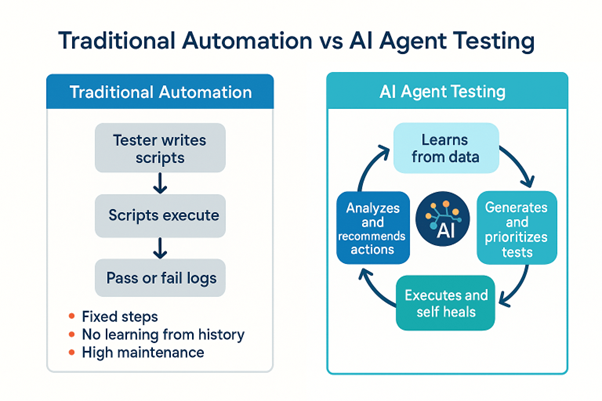
Following are brief comparison between Traditional automation and autonomous agents.
Technical Challenges
Despite the promise, several engineering challenges remain:
1. Determinism vs Probabilistic AI
LLMs are non-deterministic. Testing requires reproducibility.
2. Hallucinated Assertions
Agents may infer incorrect business rules.
3. Security & Compliance
Access to logs, test data, and production-like environments must be tightly controlled.
4. Cost Control
Continuous AI inference at scale can become expensive.
Where This Is Heading
Over the next 3–5 years:
- Test engineers evolving into AI supervisors
- Test cases will become intent-driven, not script-driven
- Self-maintaining regression suites
- Continuous verification pipelines
- QA integrates deeper into DevOps & platform engineering
- Autonomous agents expand into performance and security testing
The long-term vision
A system where: Every pull request triggers an intelligent agent that understands impact, tests intelligently, explains failures, and suggests fixes.
At ALTEN we have developed ARIA (ALTEN REAL TIME INTELLIGENT AI ENGINE) tool which is trained and specialized AI assistant provides 360-degree guidance throughout the entire test design process.
Autonomous testing agents represent a paradigm shift — from scripted automation to adaptive intelligence.
The teams that learn to architect, govern, and collaborate with these agents will define the next generation of software quality.

About the Author
Anantharamu Thoremane is a Technical Specialist with over 17 years of experience in the aerospace domain, specializing in software verification and validation for safety-critical systems. He is known for driving robust technical strategies, mentoring engineering teams, and ensuring strict compliance with demanding industry standards to deliver high-integrity, mission-critical software. Passionate about innovation, Anantharamu focuses on advancing ideas that enhance system reliability, optimize processes, and support the development of next-generation aerospace technologies.